
Point of view
How Human Is AI?
It is our choice to decide how well AI integrates with our civic structures, commercial markets, and lives.

As business and civic leaders we often turn to polls, surveys, trending, and reports to assess and progress our world. We are also parents, coaches, team members, and ultimately human. Keeping a connection and a component of our strategies to enable those humans we lead, follow, and interact with is critical. This story conveys the power of a "human-forward" approach and why it is singularly important in this moment.
It is our choice to decide how well AI integrates with our civic structures, commercial markets, and lives. Our excitement, confusion, and trepidation are understandable. “AI” is the constant hum in our ears. It is everywhere — seemingly penetrating life’s mechanisms, building up a new “life as we know it,” and simultaneously tearing down many of the traditional structures of society that we are familiar with. It feels like an uncontrollable, supernatural force impacting our lives whether we choose to accept it or not.
In reality, AI is merely an evolutionary technology that we are allowing — and in most cases enabling — to interstitially weave itself into the network of man-made structures. Its immense pace is driven in part by the productivity it generates, and in part by the fact that our modern world has put very few limits on technological advancement. It is not surprising that we feel a little dumbfounded, but this is a critical time to consider our decision gates for technology and, more broadly, human agency. To make the conversation operative, let’s break this cultural juggernaut into workable chunks.
If we are to evaluate AI in our world, we need to structurally identify the components that are in play. Let’s build a quick, non-exhaustive entity-relationship diagram to visualize this.
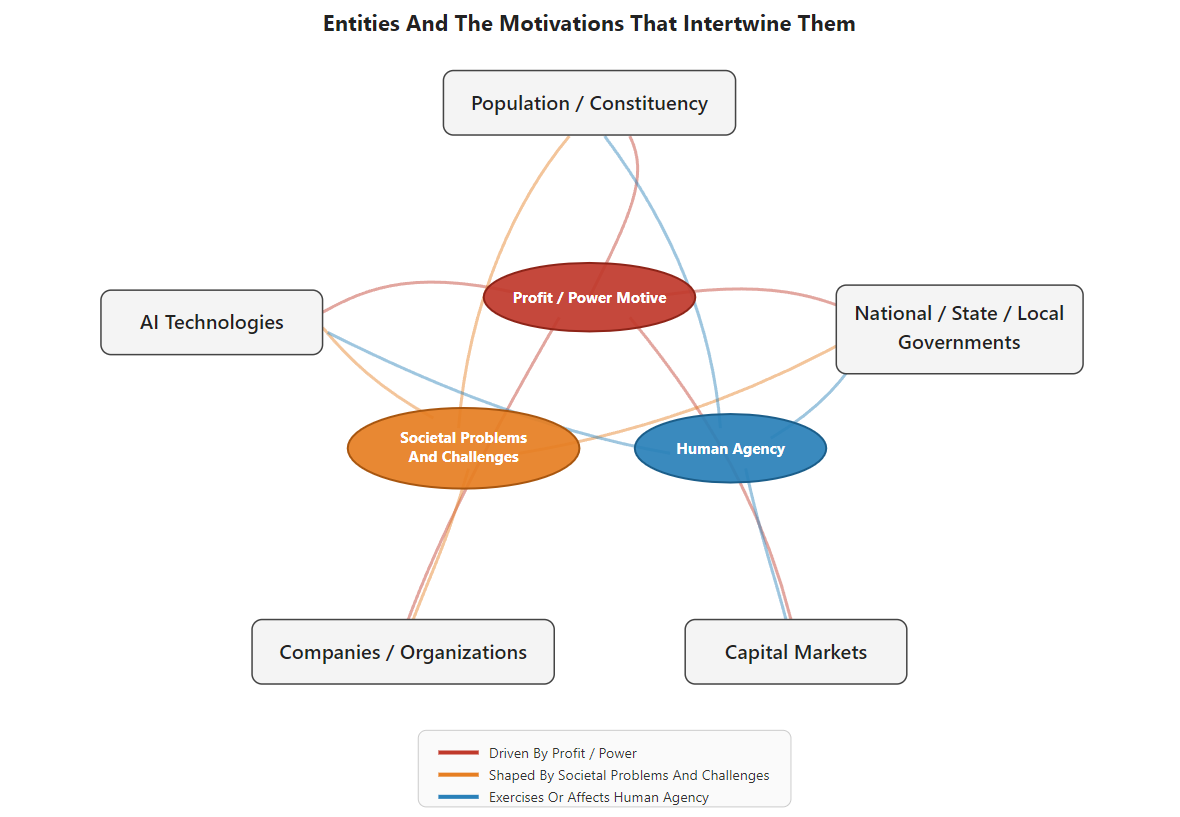
For our discussion, let’s use the diagram's entities and motivations as a hypothetical frame. Here is a sample of the components AI interacts with:
- Population / Constituency: The first component is ourselves, the humans. Some are family and friends, some are strangers, some are foreigners, some possess wealth, some face health problems, and some need support for the basic staples of life.
- Governments: Historically, we have lived in civilized groups that govern life. Optimally, culture evolves in a manner that rewards initiative, provides personal freedoms, protects its constituents from danger, and lifts up those living with challenges. That said, governments are burdened by politics, conflict, and the natural shifts of society.
- Companies: Since the British began forming corporate entities in the 1550s, human enterprise has evolved to establish corporations that can now be larger and more powerful than the governments that regulate them.
- Capital Markets: We have traded goods and services within global markets for many millennia. It is a complex network of interaction between suppliers and buyers. The access and scale of modern digital markets have expanded and consolidated into a seemingly infinite global fabric of trade. This scale has also centralized influence and silenced smaller players, who are often subjugated by the powerful owners of these market channels.
The sample entities above are interconnected through motivations that drive progress and direction. Let’s look at some of the critical motivations in play that are associated with the rise of Artificial Intelligence:
- Profit / Power Motive: This is a driving force for a segment of humanity that leads to industrial advancement and improved lives, as well as greed and oppression. Adam Smith called the natural balance of supply and demand the “invisible hand” that governs itself; in reality, humans often suffer greatly during those market corrections. Add to that there is no defined perfect balance of wealth, but it can be assessed that we currently live within a massive imbalance, and that factor seems to increase human suffering.
- Societal Problems and Challenges: Each era of humanity has confronted moderate to existential challenges that it has had to navigate, overcome, or defend against. These include overpopulation, poverty, conflict, pollution, social inequity, and crime. With each new era, the dynamics of these complex interactions create new obstacles to contend with.
- Human Agency: Since the governmental revolutions of the 18th century — and later boosted by computing technology — the modern world has established the concept of the empowered individual. An individual can live self-sufficiently in the modern world without the resources previously required, such as land, family, or kin. While the individual is an iconic identity in Western culture, this perspective has also left people isolated and at risk. Issues surrounding privacy, news legitimacy, contact integrity, and the monetization of the individual as a product have left many feeling mentally unbalanced and concerned about their security in this ongoing paradigm. At a macro level, corporate centralization for profit and efficiency, consolidated markets, reduced competition, and the tendency of technology firms to exclusively entrench themselves, have weakened individual agency. Most of the digital functionality an individual uses today is controlled by six to eight global companies. The result is a pervasive epidemic of mistrust.
The point can be made that AI is not the root cause of our current problems, but rather a reflection of the weaknesses in a societal structure meant to protect human freedom, safety, agency, and happiness. It serves as a litmus test, revealing how unprepared we were for its arrival. AI accelerates both the good and the bad equally, moving through our society at a pace that highlights how little structure we have in place to consider it, and then govern it.
Historically, humanity has rarely said “no” to technology. Even nuclear capabilities have undergone significant development, and we continue to struggle to consistently control their proliferation and use. It is not surprising that AI encountered very few obstacles to unfettered growth within free-market economies run by governments already burdened by these evolving challenges; and by defining our constituencies primarily as "individuals," we have effectively isolated each player to navigate the game board alone.
The good news, to borrow a common phrasing: "this is our wake-up call." We collectively need to recognize that we have a problem: not AI itself, but our inability to manage how new technologies reshape our world. We must move together toward recognition, recovery, and remediation. It is time to regain our balance, find our footing, and right the ship. AI serves as an ideal focal point for these improvement efforts. Our goal today is to frame some of the components involved — not to solve the problem outright, but to establish key considerations as we work to make AI more human.
To make AI more human, we can start by:
- Putting Humans First: Ultimately, we are all human. Prioritizing the human condition of everyone involved must be central. There will be opposition to this; the "Us vs. Them" mindset is a strong impulse that quickly builds defenses against better human-centered strategies. It is time to move past this narrative. A popular quote attributed to Mahatma Gandhi notes: "There is enough for everyone's need, but not for everyone's greed." Modern society is currently scoring poorly in consistent global human welfare. Recent years stand out as particularly challenging moments in modern history. If you read the news over a few days and keep a tally in two columns: Column One: "Human Conflict" and Column Two: "Human Cooperation." What does the score look like? Ultimately, a human-forward mindset is essential to effecting meaningful change.
- Evaluating Your Daily Reactions: In a world designed around individual motives to persuade and monetize, we must adapt our behaviors both individually and collectively. Question your emotional response to information: Are you fearful? Angry? Calm? Why? Regardless of whether you enjoy the effect, notice it and understand how technology generated that response. Consider applying this same observation to the people you interact with throughout your day.
- Reward responsible actors: Purchasing power is a significant driver in our economic system. Consumers collectively hold immense influence. We need to invest time in understanding the entities and channels we purchase from, directing our capital toward those that align with shared societal goals. You do not need a complete overhaul to make an impact; incremental shifts still drive notable differences.
- Define and defend our cultural anchors: We rely on strong societal structures. We must protect the best of our educational, communal, scientific, and spiritual institutions — the tenets that provide pathways to reflect, repair, and strengthen our communities.
How do we make AI more human? AI is a productive technology devoid of inherent values. To become more human, it must operate within a human-forward culture that determines how the technology progresses, enforces clear limitations, and directs resources in a way that serves the broader public. Technology will never fix itself.